
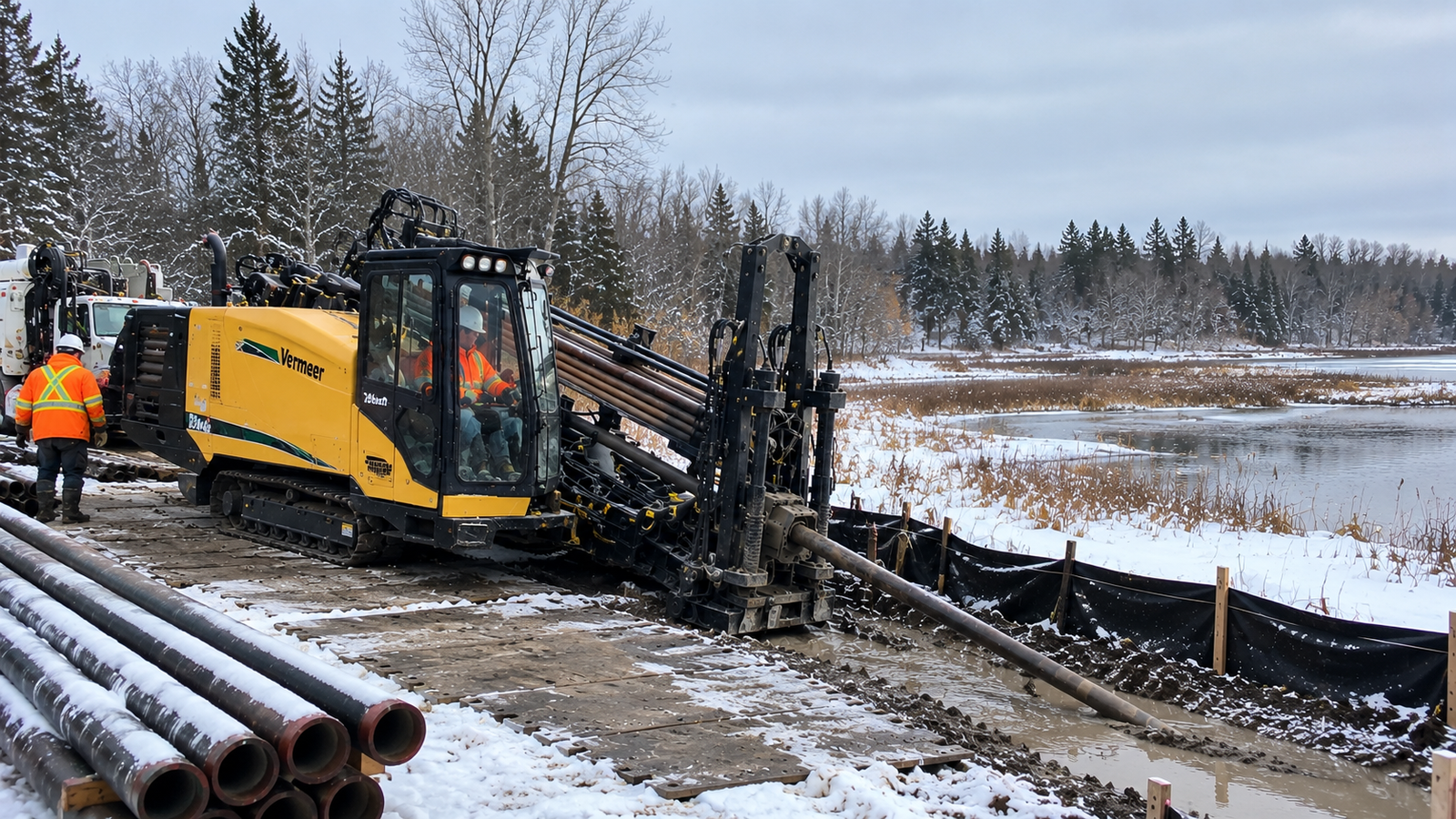

Quick answer: Yes, horizontal directional drilling can be done in an Ontario winter. The bore runs below the frost line, where ground conditions don’t change with the season. Crews adapt only the surface work: heated hydrovac for the entry and exit pits, sheltered drilling fluid and pipe fusion, careful locates under snow, and temporary pit restoration until spring.
Key takeaways
- Frost affects the surface, not the bore path below the frost line.
- Only two small pits touch frozen ground, and heated hydrovac opens them cleanly.
- Drilling fluid and HDPE fusion need shelter and cold-weather procedures, not a pause until spring.
- Locates work year-round through Ontario Dig Authority (formerly Ontario One Call); plan for snow covering the marks.
- Spring reduced load periods on municipal roads can delay equipment until May, so late winter is often the better window.
It happens on a lot of projects. Design approvals took longer than planned, the contractor was booked through the fall, and now the utility crossing that was supposed to be done in October is staring down an Ontario winter. The assumption is that underground work stops when the ground freezes, so the crossing waits until April. That means a road opening, a building hand-over or a new service connection slips by months.
Horizontal directional drilling in winter is a different story. Because HDD installs the pipe or conduit through a bore path below the surface, with work concentrated at two small pits, most of what makes winter excavation difficult doesn’t apply. Winter HDD isn’t a summer job done in the cold. It’s a planned operation with a few specific adjustments, and when those are handled properly, the crossing gets built on schedule.
Here are the seven ways an experienced horizontal directional drilling crew keeps utility crossings moving through an Ontario winter, and what project owners should plan for.
Can HDD Be Done When the Ground Is Frozen?
Frost works from the top down. In Central Ontario, the ground freezes to a depth that depends on the winter, the soil, snow cover and whether the surface is cleared pavement or insulated lawn. Below that depth, the ground stays at roughly the same temperature it was in the fall.
An open trench has to cut through that frozen layer along the entire route, then backfill and compact frozen material, which is exactly what specifications warn against. An HDD bore only breaks the surface at the entry and exit points. Everything in between happens in ground that behaves the same in January as it did in September.
Utility lines in Ontario are designed to sit below frost penetration depth anyway, so water services don’t freeze and conduit doesn’t heave. Frost penetration depths are set out in provincial standards (OPSD 3090.101) and in each municipality’s design criteria.
1. Drill Below the Frost Line, Where the Ground Doesn’t Change
That works in winter HDD’s favour. The bore profile is planned to stay below the frozen layer along the crossing, so the drill head, reamer and pipe move through unfrozen soil. Steering, tracking and reaming work the way they do the rest of the year.
2. Open Entry and Exit Pits With Heated Hydrovac, Not Brute Force
Breaking frozen ground with an excavator bucket is slow, rough on equipment, and imprecise, which matters when existing utilities are close to the pits. On winter HDD jobs, the better tool is a heated hydrovac unit.
Heated water thaws and cuts through the frozen crust while the vacuum removes the material, so pits can be opened cleanly and to the exact size needed. Because there’s no mechanical contact, nearby gas, hydro and telecom services stay protected, even when frost makes it harder to judge what’s underneath.
The same hydrovac support handles potholing to confirm utility depths along the bore path, and it stays on site to manage drilling fluid at the pits during the bore.
3. Keep Drilling Fluid Moving and Above Freezing
Drilling fluid, usually a bentonite-based mix, does three jobs during a bore. It cools the tooling, holds the hole open, and carries cuttings back to the surface. In freezing weather, the fluid system is where problems start if nobody plans for it.
Industry guidance is blunt about this. Mud pumps and lines can freeze within 10 to 15 minutes at -15 to -20 °C if fluid stops moving, and some fluid additives lose effectiveness once they’ve been frozen and thawed Trenchless Technology.
Winter-ready crews manage that with:
- Sheltered and heated mixing and recycling equipment
- Lines purged at breaks, tool changes and end of shift
- Fluid products stored in heated space
- On-site mud recycling, so less fresh water has to be heated and less spent fluid leaves site
For the project owner, the point is simple. Ask how the contractor manages fluid in the cold. A crew that can answer in detail is a crew that won’t lose a day to a frozen pump.
4. Fuse the Pipe String Under Shelter, With Logged Procedures
Most HDD crossings use HDPE pipe, fused into one continuous string before pullback. Cold weather affects fusion. Pipe ends lose heat faster, frost and moisture on the pipe surface can contaminate a joint, and wind pulls heat away from the fusion zone.
The fix isn’t to skip winter fusion. It’s to control the conditions:
- Fuse inside a shelter or windbreak
- Keep pipe ends clean, dry and frost-free
- Follow the pipe and fusion machine manufacturers’ cold-weather procedures for heating and cooling times
- Record fusion parameters for every joint
When pipe is fused on site by the same crew that drills the crossing, the string is ready when the bore is, with no waiting on a separate subcontractor to work around the weather.
5. Plan Locates and Potholing Around Snow Cover
Every bore starts with locates, and Ontario’s locate system works year-round. Ontario One Call, now Ontario Dig Authority, still takes requests in winter. What changes is how long marks last and how easily they’re found.
Snow covers paint and flags, plows push snow over marked areas, and a mid-winter thaw can erase marks entirely. Good winter planning means:
- Requesting locates close to the start date
- Asking locators to use flags or offset stakes where snow is expected
- Keeping the area clear of snow storage until marks are confirmed
- Potholing crossings along the bore path early, before the ground gets harder
The locate marks show roughly where a line is, not how deep it is. Potholing with hydrovac gives the actual depth, which is what the bore profile is built around in any season.
6. Restore the Pits Temporarily Now, Permanently in Spring
This is where winter HDD saves the most compared with winter trenching. Asphalt plants close for the season, sod can’t be laid on frozen ground, and compaction of frozen backfill isn’t accepted. So any winter excavation ends with temporary restoration that has to be redone in spring.
With open-cut, that temporary surface runs the full length of the trench, often along a road or across a lot people are still using. With HDD, there are only two small pits to restore. They’re backfilled and made safe with temporary surfacing for the winter, then finished once asphalt and topsoil work resume.
The road, driveway, parking lot or lawn between the pits is never opened, so it stays in normal use all winter. There’s no long patch to maintain through freeze-thaw cycles and no settlement claims along a trench line in spring.
When Waiting for Spring Makes Sense
Winter HDD isn’t the answer for every project, and an honest contractor will say so. Waiting may be the better call when:
- The crossing is very shallow, so most of the bore sits inside the frozen layer
- Pits can’t be accessed safely because of snow storage, ice or site constraints
- An extended cold snap makes fluid and fusion control impractical for a few days
- A permit or environmental approval has seasonal timing conditions, such as in-water work windows near fish habitat
In most of those cases, the answer is to schedule around the issue, not to cancel the winter plan. A short pause during a deep freeze costs far less time than pushing the whole crossing to May.
Where the Savings Come From
The value of winter HDD doesn’t come from a lower price on the bore itself. It comes from what doesn’t happen:
- No schedule slip. The building, road or service connection isn’t held up for months waiting on one crossing.
- No trench through frozen ground. No slow excavation, no frozen backfill, no long temporary patch to maintain.
- Normal use of the area all winter. Roads, entrances, parking and driveways stay open between the two pits.
- Minimal spring restoration. Two small pits to finish instead of the full length of a trench.
- Protected surroundings. Trees, landscaping and nearby structures along the route are never disturbed.
| In winter | HDD crossing | Open-cut trench |
| Ground excavated | Two small pits | Full length of the route |
| Frozen ground to break | Pits only, with heated hydrovac | Entire trench line |
| Surface use during the work | Road, lot or lawn stays open between pits | Closed or detoured along the trench |
| Backfill | Pits only | Full trench, frozen material not accepted |
| Spring restoration | Two small pits | Full trench length |
| Trees, landscaping, structures on the route | Not disturbed | Disturbed along the trench |
Plan Your Winter Crossing With CC Underground
CC Underground has been drilling in Ontario since 1987, with HDD rigs from compact to large production units, hydrovac support, on-site mud recycling and in-house pipe fusion. That means the drilling, the pits and the pipe are handled by one team on one schedule, which matters most when the weather is working against you.
If a crossing on your project has slipped into winter, talk to our team before you assume it has to wait. We’ll look at the site, the depth, the ground and your deadline, and tell you honestly whether winter HDD makes sense. Contact CC Underground or call (705) 327-2751.
Frequently Asked Questions
Q. Can horizontal directional drilling be done in winter in Ontario?
A. Yes. Because the bore runs below the frost line, the drilling itself happens in unfrozen ground. Crews adjust how they open pits, manage drilling fluid and fuse pipe, but most crossings can be completed through the winter.
Q. Does frozen ground affect the bore?
Only near the entry and exit points, where the bore passes through the frozen surface layer. The rest of the bore path is below frost depth, where ground conditions are much the same as in summer.
Q. How are entry and exit pits dug in frozen ground?
Usually with heated hydrovac. Heated water cuts through the frozen crust and the vacuum removes the material, which is cleaner and safer around existing utilities than breaking frost with an excavator.
Q. Does HDD take longer in winter?
Set-up and pit work can take longer, and crews may pause during extreme cold snaps. The bore itself proceeds much as it would in other seasons. Planning ahead keeps the overall schedule close to a fall timeline.
Q. Will my property be torn up until spring?
No. Only the two pits need restoring. They get temporary surfacing over the winter and are finished in spring. Everything between them, such as a road, driveway, lot or lawn, is never opened and stays in normal use.
Q. Can locates be done when there’s snow on the ground?
Yes. Ontario Dig Authority (formerly Ontario One Call) accepts locate requests year-round. Snow can hide marks, so request locates close to your start date, ask for flags or offsets, and keep the area clear until the crew confirms them.
Q. Is it better to wait until spring?
Not usually. Spring brings thaw conditions and reduced load periods on many municipal roads, which can delay heavy equipment until May. If the crossing is deep enough and the site is accessible, winter is often the faster option.