

When an underground sewer starts showing cracks, infiltration, damaged joints, or structural deterioration, the next step isn’t always obvious.
Should the existing pipe be rehabilitated, or does the project need to replace it?
That decision matters for municipalities, utility owners, engineers, contractors, and project managers working with aging underground infrastructure.
Two trenchless methods that may come into the discussion are Cured-in-Place Pipe (CIPP) and pipe bursting. Both can reduce the need for continuous open excavation, but they approach a failing pipeline in different ways.
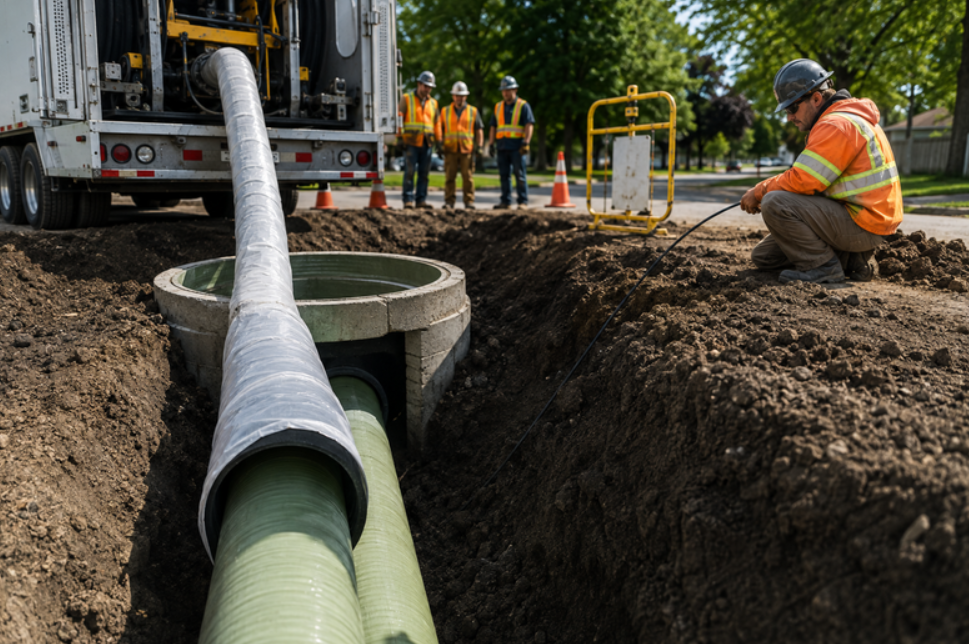
CIPP rehabilitates the existing pipe by installing a liner inside it. Pipe bursting takes a replacement approach, fracturing or splitting the existing pipe while installing a new pipe along substantially the same alignment.
So which one makes sense?
The answer depends on the condition of the existing pipe, hydraulic capacity, service connections, surrounding utilities, access, soil conditions, and what the project needs the pipeline to accomplish.
CIPP vs. Pipe Bursting: What’s the Difference?
The basic distinction is straightforward:
CIPP rehabilitates the existing pipe. Pipe bursting replaces it.
With CIPP, the existing pipeline remains in place and serves as the host for a cured liner.
With pipe bursting, the existing pipeline is fractured or displaced while a new pipe is installed along the existing alignment. Depending on the project, the replacement pipe can also be larger than the original.
| Consideration | CIPP | Pipe Bursting |
| Primary purpose | Rehabilitation | Replacement |
| Existing pipe | Remains as host | Fractured or displaced |
| New pipe | Cured liner | New replacement pipe |
| Upsizing | Limited by existing geometry | Possible where conditions permit |
| Surface disruption | Generally limited | Generally limited, but access pits are required |
| Main consideration | Condition and suitability of host pipe | Alignment, soil, access and surrounding infrastructure |
| Project objective | Renew the existing pipeline | Install a new pipeline |
Neither method is automatically the better option.
The existing infrastructure and project requirements should determine which method is worth evaluating.
Start With the Condition of the Existing Pipe
Before comparing CIPP with pipe bursting, find out what is actually happening inside the pipeline.
A CCTV inspection can identify:
- Cracks and fractures
- Infiltration
- Root intrusion
- Joint defects
- Corrosion
- Deformation
- Structural deterioration
- Blockages
- Obstructions
- Collapsed sections
- Service connections
But identifying a defect is only the beginning.
A sewer with infiltration and joint defects may still be suitable for rehabilitation. A severely deformed or collapsed pipeline presents a different problem and may require replacement.
Ontario’s Design Guidelines for Sewage Works identify host-pipe condition, hydraulic capacity before and after rehabilitation, and the number of service laterals as factors to consider when selecting a sewer rehabilitation technique.
The key question is:
Can the existing pipe support the proposed rehabilitation and still meet the project’s requirements?
If it can, CIPP may be worth evaluating.
If it cannot, replacement options need to be considered.
When Does CIPP Make Sense?
CIPP may be appropriate when the existing pipeline remains a suitable host and the project objective is to rehabilitate the existing asset.
Conditions that may lead to a CIPP evaluation include:
- Cracking
- Infiltration
- Root intrusion
- Joint defects
- Corrosion
- Loss of watertightness
- Localized deterioration
- Certain forms of structural deterioration
CIPP can also be useful when maintaining the existing alignment and limiting continuous surface excavation are important project considerations.
However, CIPP is not a solution for every damaged pipe.
The host pipe needs to be evaluated for its condition, geometry, access, hydraulic requirements, existing obstructions, service connections, and compatibility with the proposed lining system.
For example, significant deformation or severe offsets can affect whether lining is practical. The specific rehabilitation system and design determine what conditions can be accommodated.
The better question isn’t:
“Can we put a liner in this pipe?”
It is:
“Can this existing pipe be rehabilitated to meet the structural and hydraulic requirements of the project?”
When Should Pipe Bursting Be Considered?
Pipe bursting becomes more relevant when the project requires replacement rather than rehabilitation.
It may be evaluated when:
- The existing pipe has significant structural deterioration
- Sections have collapsed
- The existing pipe is unsuitable as a rehabilitation host
- A new pipe is required
- Additional capacity is needed
- Upsizing is part of the project objective
- The existing alignment is suitable
- Soil and site conditions support the installation
Ontario’s design guidance identifies pipe bursting as a trenchless option for replacing damaged water and sewer pipes and notes its potential for enlarging existing sewer lines with limited excavation.
But a pipe that needs replacement is not automatically a pipe that should be burst.
Pipe bursting still needs to be evaluated against the actual site.
What If the Existing Pipe Is Undersized?
A pipeline can have two problems at the same time:
It is deteriorated, and it is undersized.
That changes the decision.
CIPP installs a liner inside the existing pipe, so the finished internal diameter is affected by the liner design. Hydraulic capacity therefore needs to be considered during rehabilitation design.
Pipe bursting can provide an opportunity to install a larger replacement pipe where project conditions permit.
Before selecting a method, ask:
Does the project need to restore the existing pipe, or does it need more capacity?
If additional capacity is required, replacement and potential upsizing should be evaluated rather than assuming rehabilitation will solve the entire problem.
Service Laterals Can Change the Project
The main sewer is only part of the system.
Municipal sewer sections may have multiple service laterals connecting properties to the main, and those connections need to be identified before work begins.
The project team should understand:
- How many laterals are present
- Where they connect
- Their condition
- How they will be accessed
- How they will be reinstated
- Whether temporary service arrangements are required
Ontario’s design guidance specifically identifies the number of service laterals as one consideration when selecting sewer rehabilitation techniques.
A method that looks straightforward when considering only the mainline can become more involved once service connections are included.
How Nearby Utilities Affect the Decision
Underground infrastructure rarely exists by itself.
An existing sewer may run beside or cross:
- Watermains
- Gas lines
- Electrical infrastructure
- Telecommunications
- Fibre
- Other pipelines
- Utility services
- Foundations
- Roads and other structures
This is particularly important when pipe bursting is being considered.
Because the existing pipe is fractured and displaced into the surrounding ground, the project team needs to understand what is located around the pipeline.
Soil conditions, burial depth, alignment, access, and separation from other utilities are among the factors that can affect pipe-bursting applications. Current utility information and, where required, physical confirmation should be part of the planning process before a bursting method is finalized.
For a congested utility corridor, the question isn’t simply:
“Can this pipe be burst?”
It’s:
“Can the replacement be completed while properly accounting for the infrastructure around it?”
That requires appropriate site investigation and utility coordination before the method is finalized.
Trenchless Does Not Mean No Excavation
Both CIPP and pipe bursting can reduce continuous open-cut excavation, but neither should be described as requiring zero excavation.
Depending on the application, CIPP may use existing manholes or other access points.
Pipe bursting generally requires access for the bursting equipment and replacement pipe, commonly through launch and receiving pits.
The useful comparison isn’t which method has no excavation.
It’s:
“Which feasible method provides the required result with the least overall construction disruption?”
That can include:
- Access
- Traffic control
- Utility coordination
- Bypass requirements
- Service reconnections
- Restoration
- Equipment setup
- Working space
Why CCTV Inspection Should Come Before Method Selection
A strong rehabilitation project starts with information.
A practical process is:
Existing records → CCTV inspection → condition assessment → hydraulic review → utility investigation → site assessment → method comparison → project design
The inspection should answer more than whether the pipe is old.
It should help determine:
- What is failing?
- How severe is the problem?
- Is the pipe structurally stable?
- Can it serve as a rehabilitation host?
- Is its capacity adequate?
- How many service connections are involved?
- What utilities surround the alignment?
- What access is available?
Once those questions are answered, the comparison between CIPP and pipe bursting becomes much more useful.
CIPP vs. Pipe Bursting: What About Cost?
Cost is important, but it should not be the only deciding factor.
There is no single cost that applies to every CIPP or pipe-bursting project.
Project cost can be affected by:
- Pipe diameter
- Pipeline length
- Depth
- Existing pipe condition
- Number of service laterals
- Access requirements
- Bypass requirements
- Traffic control
- Utility conflicts
- Soil conditions
- Equipment
- Labour
- Inspection and testing
- Restoration
- Required capacity
A CIPP project may require cleaning, flow management, liner installation, curing, connection reinstatement, and inspection.
A pipe-bursting project may involve launch and receiving pits, replacement pipe, utility assessment, reconnections, and restoration.
For that reason, comparing only the cost of the primary trenchless operation gives an incomplete picture.
There is no responsible universal answer that CIPP is always cheaper or that pipe bursting is always faster.
The better question is:
Which method meets the project’s requirements within the overall construction conditions?
When CIPP May Not Be the Right Choice
CIPP should not be selected simply because it is trenchless.
The approach may need to be reconsidered when:
- The host pipe is severely unstable
- Significant deformation prevents suitable installation
- Obstructions cannot be adequately addressed
- Required hydraulic performance cannot be achieved
- The proposed rehabilitation system is not appropriate for the service conditions
- The project requires a new or larger pipe
The actual pipe condition and rehabilitation design need to be evaluated before deciding.
When Pipe Bursting May Not Be the Right Choice
Pipe bursting also has limitations.
Before selecting it, evaluate:
- Soil conditions
- Existing pipe material
- Pipe diameter
- Alignment
- Bends
- Burial depth
- Nearby utilities
- Access
- Service connections
- Required replacement diameter
- Potential impacts to surrounding infrastructure
If those conditions do not support bursting, another replacement or rehabilitation method may be more appropriate.
Four Situations Where the Decision Changes
The pipe has infiltration and joint defects
CCTV shows infiltration and damaged joints, but the pipeline remains continuous and suitable for rehabilitation.
CIPP may be worth evaluating.
The project is primarily focused on rehabilitating the existing pipeline.
The pipe has severe structural deterioration
The existing pipeline has major structural defects or collapsed sections.
Replacement methods should be evaluated.
Pipe bursting may be one option if the site conditions support it.
The pipe is deteriorated and undersized
The project needs structural renewal, but the existing diameter is also insufficient.
Replacement and potential upsizing should be evaluated.
Rehabilitating the existing diameter may not address the capacity requirement.
The pipe runs through a congested utility corridor
The sewer is surrounded by other underground infrastructure.
Site and utility conditions become a major part of the decision.
The fact that a method is trenchless does not remove the need to understand what is around the existing pipeline.
CIPP vs. Pipe Bursting: Quick Decision Guide
| If the project has… | Start by evaluating… |
| Cracking or infiltration | CIPP and other rehabilitation options |
| Joint defects | CIPP may be appropriate |
| A suitable host pipe | CIPP |
| Severe structural deterioration | Replacement options |
| Collapsed sections | Replacement options |
| Insufficient capacity | Replacement and upsizing options |
| Multiple service laterals | Connection requirements |
| Congested utilities | Detailed site assessment |
| Suitable alignment and soil | Pipe bursting may be feasible |
| Need for a new pipe | Pipe bursting and other replacement methods |
This is a screening guide, not a substitute for project-specific engineering assessment.
Practical Checklist Before Choosing CIPP or Pipe Bursting
Before selecting a method, confirm:
- CCTV inspection completed
- Pipe condition documented
- Existing pipe material identified
- Pipe diameter and alignment confirmed
- Hydraulic capacity reviewed
- Host-pipe suitability evaluated
- Service laterals identified
- Nearby utilities identified
- Soil conditions reviewed
- Burial depth confirmed
- Access requirements evaluated
- Traffic impacts considered
- Bypass requirements reviewed
- Restoration requirements considered
- Rehabilitation and replacement options compared
If several of these questions remain unanswered, it may be too early to select the construction method.