

- Hydrovac excavation uses two systems simultaneously: a high-pressure water system that breaks up soil and an industrial vacuum that removes the resulting slurry into an onboard debris tank.
- Water pressure, nozzle configuration, and vacuum draw are adjusted to match soil type, ground conditions, and the sensitivity of infrastructure adjacent to the excavation zone.
- Heated water systems allow hydrovac to operate effectively in frozen ground. Not all units carry this capability. Confirm it before scheduling any winter work in Ontario.
- On HDD projects, hydrovac serves two separate roles: pre-construction utility potholing along the bore path and drilling fluid removal during boring operations.
- Ministry of Environment certification for contaminated soil haulage is a provincial regulatory requirement in Ontario. It is not a preference. Confirm it before mobilizing on any regulated material scope.
- High-rail gear allows hydrovac trucks to operate in active rail corridors. Standard hydrovac trucks cannot access rail environments regardless of the operator’s experience level.
- Hydrovac is specified by condition, not by default. Understanding the site factors that require it prevents both under-specification and over-specification on Ontario projects.
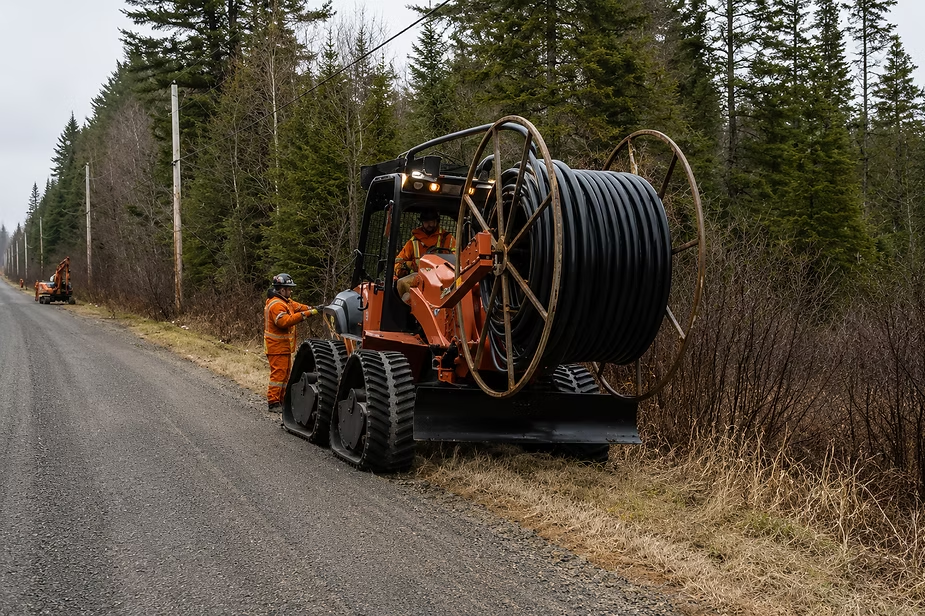
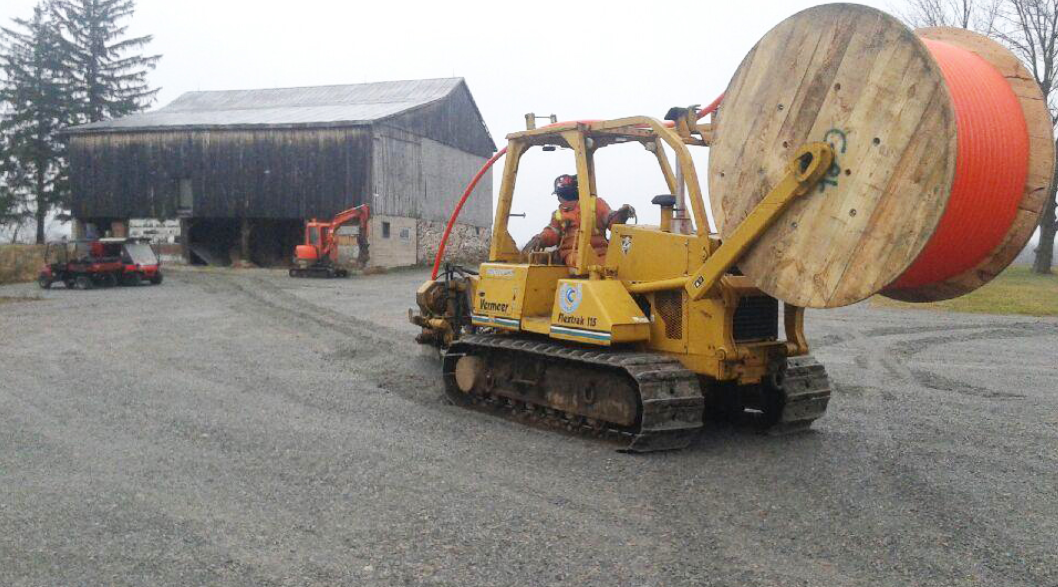
Utility ploughing is a method of underground utility installation that uses a hollow vibrating blade attached to tracked or wheeled equipment to cut through soil and simultaneously place pipe or cable at the required depth. No trench is opened, no soil is removed, and the surface above the installation line is left with minimal disturbance after the machine passes. For long-run utility installation projects across Ontario where existing underground congestion is not a constraint, it is one of the fastest installation methods available.
How Utility Ploughing Works
The process relies on a hollow blade mounted on the front or undercarriage of a tracked or wheeled machine. The blade is driven into the ground to the required installation depth and the machine moves forward along the installation route.
The Vibrating Blade Mechanism: The blade vibrates at high speed during operation. This vibration is what makes the method efficient. Instead of forcing the blade through soil using the machine’s weight and traction alone, the vibrating action fractures and loosens soil ahead of the cutting edge, reducing resistance and allowing the blade to move forward at a significantly faster rate than a static blade or a conventional trenching chain.
Soil compaction, moisture content, and the presence of rock or hardpan are the site conditions that determine whether utility ploughing is practical on a given alignment. In high clay content soils, moisture acts as a lubricant and the blade moves through efficiently. In highly compacted subgrade, dry rocky fill, or rock formations, resistance increases significantly and production slows or stops. A soil assessment before specifying ploughing prevents mobilizing equipment to a site where it cannot perform.
How the Product Is Placed at Depth: The hollow centre of the blade is what separates a utility plough from a ripper or subsoiler. Pipe or cable is fed through the hollow blade from a reel mounted on the machine. As the blade advances and cuts the slot, the product spools out through the blade exit and is placed in the ground at the correct depth in a single pass. The slot closes behind the blade as the machine moves forward.
No excavation remains open after installation. No spoil sits on the surface. No backfill operation is required. This single-pass process is the primary efficiency advantage utility ploughing holds over open-cut trenching on long straight runs in open terrain.
Fleet and Equipment: CC Underground operates an extensive fleet of utility ploughs across a range of machine sizes for different project types. Smaller tracked units work in limited-access areas and residential lots. Larger machines handle long rural runs, heavier pipe sizes, and more demanding soil conditions. Machine selection depends on the product being installed, the terrain, and the access constraints on the alignment.
What Utility Ploughing Installs
The hollow blade accommodates a wide range of products from small diameter cables to larger utility pipe depending on the machine and blade configuration. CC Underground installs the following using utility ploughing methods:
● Water lines
● Power cables
● Fibre optic communication cables
● Utility ducts and conduits
● Fuel lines
All types and sizes of pipes and cables can be installed across diverse terrain and soil conditions, including rural open fields, road allowances, residential properties, and challenging landscape conditions where surface disruption needs to be minimized.
Ontario One Call Requirements and Utility Ploughing
Under the Ontario Underground Infrastructure Notification System Act, 2012, all excavators must contact Ontario One Call before any ground disturbance. This requirement applies to utility ploughing in the same way it applies to trenching, drilling, or any other excavation method.
Utility ploughing is well suited to open terrain where no buried utilities are present. The condition that makes it appropriate is also the condition that reduces locate conflict risk. On alignments where Ontario One Call locates confirm no buried infrastructure is present, ploughing proceeds efficiently and safely. On alignments where locates identify existing buried services or where utility records are incomplete, the locate information needs to be field-verified before a plough blade goes into the ground. The blade cannot steer around a buried utility the way an HDD bore can. A plough strike on a buried gas line or electrical conduit produces the same result as any other mechanical strike.
Before specifying utility ploughing on any alignment, confirm locate clearance along the full installation route. Where locates identify conflicts, reassess whether ploughing is the appropriate method for that section of the alignment or whether HDD or open-cut is required.
When Utility Ploughing Is the Right Method
Utility ploughing delivers its greatest value in specific site conditions. The table below is the decision framework for Ontario projects.
| Site Condition | Specify Utility Ploughing? |
| Open terrain with no existing utility congestion | Yes – ideal conditions. Long runs, minimal surface disturbance, fast single-pass installation. |
| Rural alignments for fibre optic or power cable | Yes – utility ploughing is the standard method for long rural cable runs across Ontario. |
| Residential lots with confirmed locate clearance | Yes – smaller plough units handle tight access. Confirm locates before mobilizing. |
| Road allowances with confirmed no buried service conflicts | Yes – efficient on road allowances where Ontario One Call locates confirm clearance. |
| Urban corridor with multiple buried utilities | No – HDD or open-cut is appropriate. The blade cannot steer around existing buried assets. |
| Crossing under roads, rail corridors, or waterways | No – HDD is the correct method for crossings requiring a steered bore path. |
| Rocky or highly compacted subgrade | No – production drops significantly. Assess soil conditions before specifying. |
| Gravity sewer requiring precise grade control | No – open-cut provides the grade control that ploughing cannot deliver. |
Utility ploughing is a preferred method where existing utility congestion and landscape obstructions are not a concern. Where congestion exists or locates are unconfirmed, HDD or open-cut trenching is the appropriate method.
Utility Ploughing vs HDD vs Open-Cut Trenching
Each of these three methods has conditions where it provides the most value. Matching the method to the project conditions prevents both over-specification and unnecessary cost.
| Factor | Utility Ploughing | HDD | Open-Cut Trenching |
| Installation speed on long runs | Very fast | Moderate | Moderate to slow |
| Surface disturbance | Minimal | Minimal | Significant |
| Suitability for congested corridors | Not suitable | Suitable | Suitable with care |
| Road, rail, and waterway crossings | Not suitable | Ideal | Requires permit and restoration |
| Depth capability | Up to six feet | 3 to 25 metres depending on rig | Any depth |
| Rocky or hard soil | Limited | Suitable with tooling | Suitable |
| Gravity sewer grade control | Not suitable | Limited | Ideal |
| Cost on long open-terrain runs | Low | Higher | Moderate to high |
| Backfill and restoration required | No | No | Yes |
Soil Conditions and Utility Ploughing Performance
Soil type is the most important site variable for utility ploughing productivity. These are the conditions that come up most frequently on Ontario projects.
Clay Soils – High clay content soils are well suited to utility ploughing. Moisture in clay acts as a lubricant, the blade cuts cleanly, and the slot closes behind the plough without leaving voids. Clay is the most common subsoil type across Ontario’s agricultural belt and is the condition under which utility ploughing performs at its most efficient.
Sandy and Loose Fill Soils – Sandy soils and loose fill present fewer resistance issues for the blade but can create problems with slot closure. When the blade advances and the product is placed, loose sandy material may not consolidate tightly around the pipe or cable. This is a condition experienced operators manage in how they control machine speed and burial depth through sandy sections.
Compacted Subgrade and Gravelled Surfaces – Highly compacted soil, road base material, and gravelled surfaces require significantly more force to cut and slow production considerably. Utility ploughing in these conditions is less efficient and in some cases impractical. A soil assessment before specifying ploughing in compacted or gravelled terrain prevents a situation where the equipment cannot maintain production on the alignment.
Rock and Hardpan: Rock and hardpan formations are not suitable for utility ploughing. The vibrating blade is designed for soil. Where rock is present along an alignment, the appropriate method is open-cut trenching with mechanical rock breaking or HDD depending on the crossing type and depth required.